Published by Jeremy. Last Updated on March 3, 2026.
Disclaimers: We use demographic data, email opt-ins, display advertising, and affiliate links to operate this site. Please review our Terms and Conditions for more information. This website is intended for those of legal drinking age in your jurisdiction.
As part of building our wine cellar, we are collecting wines to enjoy in retirement. We don't know when retirement will come for us, but when that happens, we want to have some nice wine waiting for us when we get there.
This led me to joke about buying retirement wines for my, ahem, 4-0-Wine-K, and I use the term to justify a purchase of a nice bottle that I'm probably not going to see for 20 years or more.
In past articles on this site, we've broken down topics like how to build a wine cellar for cheap and the math behind aging wine (with the takeaway that you may need a lot of bottles if you want to regularly enjoy 10, 20, and 30-year-old wine). But in this one, I wanted to go down another rabbit hole when it comes to building a wine cellar- retirement bottles.
Yes, part of building a wine cellar is having great bottles to enjoy now. Part of it is to have bottles to enjoy later. But another part of it is to have bottles to enjoy much, much later in our retirement years.
So let's go down the rabbit hole of funding our aptly named 4-0-Wine-k.
Why Buy Wine For Retirement – Time and Money

Although we've discussed this at length in other articles, as mentioned above, the simple truth is that you cannot have old bottles of wine in your cellar unless you buy old wine or collect younger bottles and age them yourself.
The former often requires a fair bit of money, whereas the latter requires a fair bit of time.
We're not against either circumstance for the right bottle. But when we think about retirement, we have to keep in mind the two things we'll probably have a whole lot less of than we have right now. Those are, you guessed it, time and money.
So part of buying bottles now to enjoy later hedges a bet on both of these elements, and we look at adding bottles to our collection as much of an investment in our future. Just as a 401k is a vehicle for cash for retirement, we treat our cellar as an equivalent for wine, and perhaps a hedge for the fact that we probably won't be wanting to drop a small fortune on older (read: expensive) bottles when living on a budget.
How We Approach Adding Retirement Wine

Whenever we go on a wine shopping trip, particularly to a store we like, we generally operate with a rule of buying wines that catch our eye to enjoy now, plus at least one bottle to forget about for retirement.
Now, sometimes this could mean buying several bottles to forget about in one go, and just one or two to enjoy now. But our starting rule is that if we are going wine shopping and buying many bottles in a single outing (typically three or more), we always buy at least one to forget about and age.
The key here is not so much that the bottle has to be held for 20+ years until we retire, but rather that we're willing to take a bottle, throw it in our cellar, and forget about it for some undetermined period of time so it can further develop. Ideally, we hope to retire young and be able to claim that all bottles in our cellar made it to “retirement”, but we also just mean future (far into the future, that is) enjoyment.
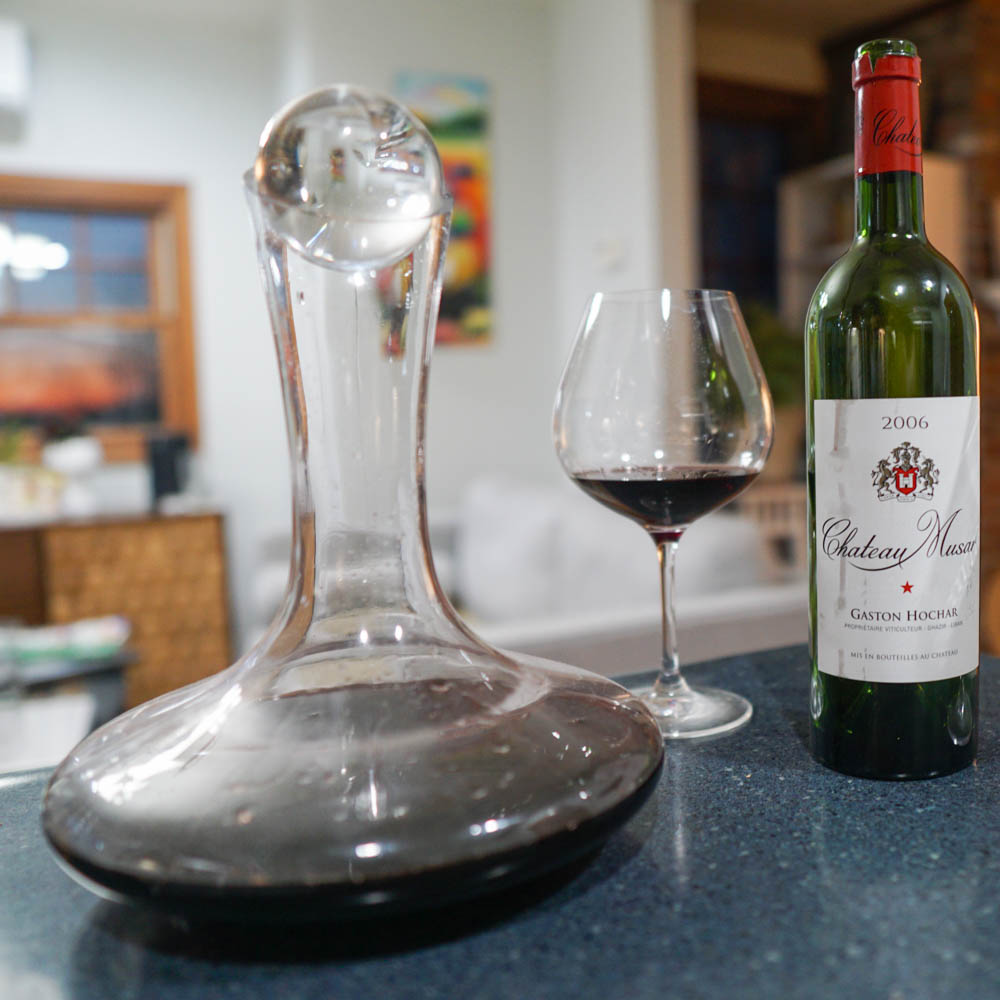
We often do this with bottles from producers we love, don't see all too often, and made a conscious decision to start collecting. Chateau Musar is a great example. Their bottles are few and far between out in stores, doubly so for ones with a bit of age already, and are ones that we are more than happy to collect and forget about in our cellar for years. So, whenever we see one and have a bit of extra cash, we grab a bottle, throw it in our cellar, and promptly forget about it.
Do we apply this logic to bottles we aren't already intimately familiar with? Sometimes. But more often than not, we use it to build out the collection of bottles we like and simply want more of.
A Three-Bottle (Minimum) Rule for Wines We Like

Another approach we were recommended by a friend is to establish a three-bottle rule. Now, we don't do this for every bottle we buy. But for producers we love, we can see the logic- particularly for retirement.
The three-bottle rule of wine is simply that if you have three bottles of any given wine in your cellar, you now have a bit of control over when to try it, namely:
- One bottle to enjoy whenever you like without restriction (“This sounds good, I want it now”)
- One bottle to check on based on a perceived aging window (“I think this wine will be good in 10-20 years, I'll check on it in 10”)
- One bottle to let ride a bit further (“I checked on this one in 10 years, but think it can still go 5-10, I'll try the last one in 7”)
You can likely see how this logic would extend to retirement wine rather well. For any set of three bottles, you have one you can enjoy now, one you can enjoy later (retirement or before), and one you may decide to let ride further. That third bottle, for us at least, will likely be the proper retirement bottle. The first and second bottles that are also aging? Well, the rules are a bit more flexible depending on our mood.
Of course, there are risks here. On one hand, you could have a bottle you love and be upset you don't have more of it on hand. Here, the three-bottle rule should be treated like a minimum count, not a maximum. If you have a bottle you really adore, three is simply a starting point. On the other hand, almost every wine out there can be too old, so you can often risk letting a bottle ride longer than it should've been, too.
As such, for any wine you have multiples of on hand, it does make a bit of sense to start a tasting schedule to hone in on the optimal drinking window. Yes, this may even mean opening one, two, three, or more bottles before a bottle is fully mature, but that is the risk we take when it comes to aging wine. As long as it is still good, that's a win in our book, and we're trying our best to have as many of those bottles on hand in retirement as we can.
Not Every Bottle Will Reach Retirement
To end this one, it's worth reiterating that we don't treat the above logic as 100% firm rules to apply for proper retirement. In a way, it is more logical to just have good wine for the future in general.
Will half of our cellar be consumed before we retire? Well, we hope not, because we hope to retire early. But if we take a standard retirement track, as of the time of publishing this article, that could still be 20+ years in the future. Not all wines age that long, and we're certainly not going to let our collection ride with a hard rule that we must be retired before opening a bottle.
When they're ready, they're ready, and we're going to enjoy them either way. That said, would a few hundred properly mature bottles be nice to have on hand in our retirement years, such that they're paid off, ready to go, and we don't have to open our wallets to acquire more? That doesn't sound too bad, either.
Still, we go back to our logic in our building our cellar math problem article that you can't have old wine unless you have enough to age over time, and, on a similar way of thinking, you can't have a fully loaded wine cellar for retirement unless you start collecting early (or, we suppose, tap into your savings in a big way later).
So if you are simply thinking about building a cellar for the future, or are building a proper retirement cellar, the above logic applies either way. When in doubt, just remember, wine is supposed to be both fun and, more importantly, consumed. So as long as you have a plan for when you will enjoy your wine and you actually do so, we can't really argue one way or another!
Do you have any plans for building a retirement wine cellar? Comment below to share!
Upgrade Your Home Wine Bar
Need to upgrade your wine bar? Grab some new wine accessories: