Published by Jeremy. Last Updated on September 28, 2026.
Disclaimers: We use demographic data, email opt-ins, display advertising, and affiliate links to operate this site. Please review our Terms and Conditions for more information. This website is intended for those of legal drinking age in your jurisdiction. To see more of our content, set us as a Preferred Source in Google.
Is there any wine region more famous than Champagne? This is debatable, of course, as there are several regions that could fit that bill. But at the end of the day, Champagne is one of the most popular regions for wine in the world, and it is easy to see why- producers here make the world’s best sparkling wine!
If you are planning a trip to Champagne, there are many things you may want to consider before you go. We’ve got you covered in this guide with tips from our visit!
Champagne Location, Regions, and Styles

Champagne is located approximately 45 minutes east of Paris by fast train from Gare de l’Est and is the northernmost wine region in France. (Click here to book your train.)
The region of Champagne itself is fairly spread out across gradually rolling hills, with many subregions found near the major towns of Reims and Epernay, including Côte des Blancs, Côte de Sezanne, Montagne de Reims, Vallee de la Marne, and more. As drive times between sub-regions can be considerable, it is worth planning a base of stay with this in mind.
However, Champagne is unique in that many producers have facilities in the major towns of Reims and Epernay, with the latter home to the famous Avenue de Champagne, just steps from the town center. So while some visitors will want to rent a car to explore, particularly those who have their hearts set on visiting specific wineries, it is quite possible to have an excellent trip to Champagne while only focusing on producers in these towns, pending your interest level (or even visiting on a day trip from Paris, if you like!).
We are not personally advocating for this, as we always recommend getting a car, but we would be remiss if we did not point out that it is feasible all the same.

So, what all should you try while visiting Champagne?
The vast majority of wines in Champagne are made with the namesake Champenoise Method (often referred to as the traditional method or Champagne method), in which secondary fermentation is allowed to take place inside the bottle (resulting in carbonation). As part of this method, the wine is aged on the lees inside the bottle to allow for unique secondary characteristics like toast, brioche, and cream to develop. That said, still wine is also produced in the region in addition to their namesake sparkling wine, and these are known as Coteaux Champenois, so be on the lookout for these bottles as well, if you are interested.
Eight grapes are approved for the production of Champagne wines; however, three, Chardonnay, Pinot Noir, and Pinot Meunier, are among the most widely used. Some bottles may be produced with a single grape, others with blends, and some regions may specialize in a specific grape- like the aptly named Côte des Blancs, which is acclaimed for its Chardonnay production.
- To simplify things a little, if you see Blanc de Blancs on a label (white from whites), it is made with white grapes, like Chardonnay, and if you see Blanc de Noirs (white from blacks), it is made from red grapes. You would do well to drink all styles and blends to find your preferences if you don’t know them already. Some are Blanc de Blancs purists, as Chardonnay has quite a high reputation, but as we drink more Champagne, we’ve found some killer bottles made with red grapes in the blend, too!
Going beyond grapes, Champagne can be made in numerous styles, from dry to sweet, white to rose, grower to negociant Champagne (an estate growing its own grapes vs buying from vineyards), and so much more. Other terms to keep in mind are things like the dosage (e.g. Nature, Extra Brut, Brut, etc.) as the amount of sugar added may give an indication of final sweetness in the wines, how long its been aged on the lees, whether it is Vintage (single year) or Non-Vintage (often blends of numerous years to try and have a uniform style), and the disgorgement date as well (when the lees were removed).
Suffice it to say, there’s a lot to keep in mind and try when visiting Champagne. So when planning your wineries, if you are not a die-hard in specific styles, we’d recommend trying a bit of everything to learn what you like!
When to Visit Champagne

Champagne is a four-season destination, with warm-to-hot summers, cold winters, and everything in between. It is also a fairly popular region to visit year-round, so deciding when to visit may come down to personal preference above all else.
Most will argue that Champagne is best visited from spring through fall, particularly because this is when vineyards look their best, but the simple truth is that you can visit at any time of year and have a good time. We visited in early December, and while we struggled to get into some wineries that had limited winter appointments (or were closed outright), we filled our tasting schedule just fine with a little extra effort.
We have read reports that January can be a hard month due to additional closures, so we recommend checking with any wineries you plan to visit about their winter schedules before making a booking in winter, just to be safe. We also consider it to be safe practice to double-check around harvest schedules as well, as small wineries often tend to be all-hands-on-deck during this season, too- possibly changing tasting availabilities slightly.
Planning Where to Stay in Champagne

The vast majority of visitors to Champagne will likely stay in one of the two major towns- Reims or Epernay.
Reims feels a bit like a conventional city, with numerous restaurants, wine bars, shops, access to the train station from Paris, and many other conventional amenities. During our visit in December, it was also home to a wonderful Christmas Market that we quite enjoyed. If you like a nice-sized French city, Reims will deliver what you seek.
Epernay, on the other hand, feels a bit more like a smaller town. The amenities are quite similar to Reims, albeit fewer overall, and felt a bit more walkable overall. We could walk to Champagne houses on the Avenue de Champagne easily from the center of town, whereas some Champagne houses in Reims may have required public transit (or, admittedly, a longer walk). That said, on some nights of the week, we found that some restaurants were closed and had to change our plans around a bit more than we expected.
For us, our decision to stay in Epernay was primarily because it was closer to the regions we wished to explore, which made our daily drive times a bit more manageable. We would have been just fine staying in Reims, too, but since we’re partial to smaller towns, it worked out well for us to save a little bit of drive time.
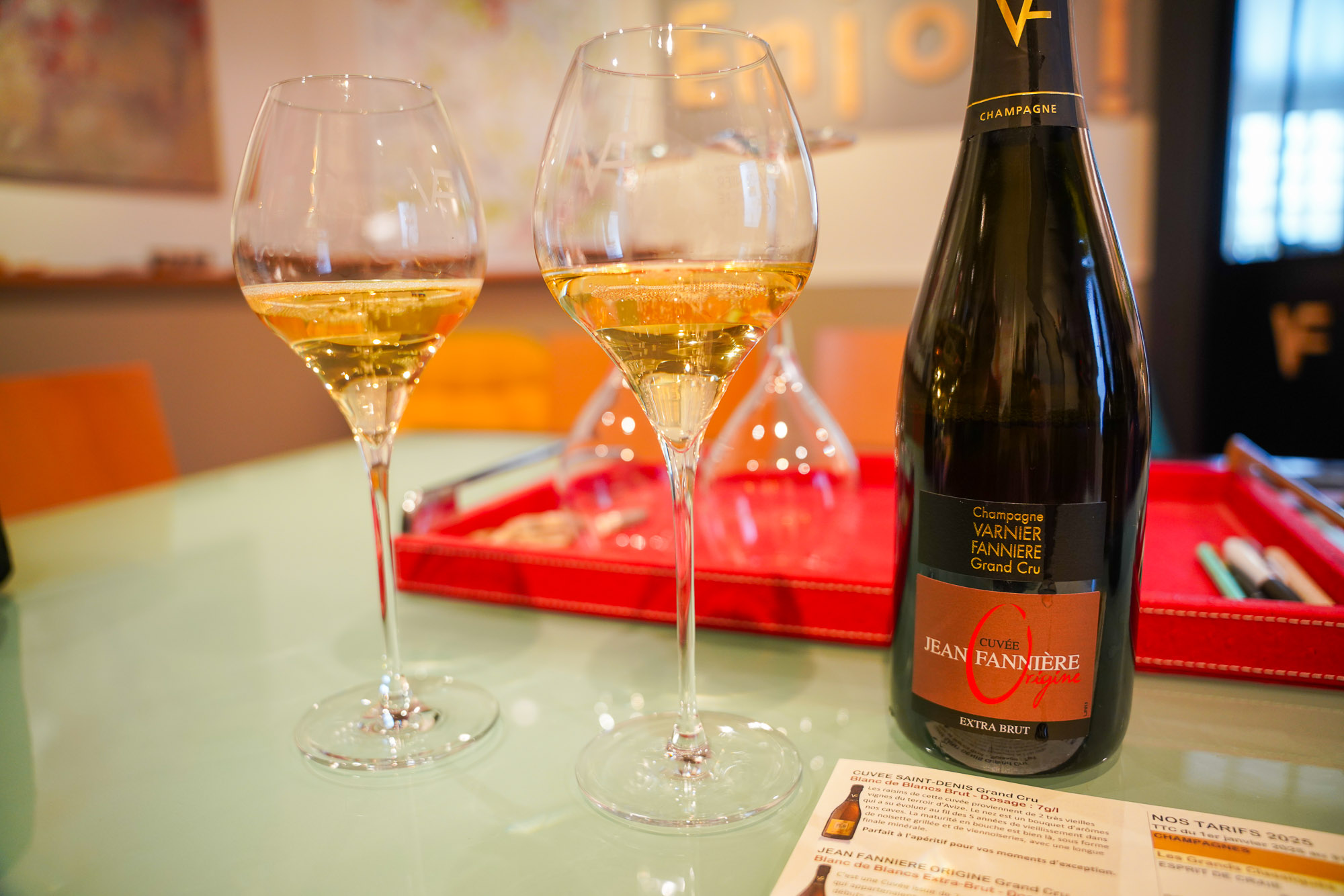
Beyond these two towns, there are numerous villages throughout Champagne with accommodations that you may want to consider. One of our favorite wineries, Varnier Fanniere, told us they have an on-site Airbnb, for example, and acclaimed wine producer Jacques Selosse also has a full boutique hotel that sometimes offers tastings of their highly sought-after wines. We visited the latter to dine at their restaurant, but would be remiss if we didn’t admit that we would’ve considered staying there if it was not fully booked by the time we committed to our trip.
While we can’t say we have visited every village in Champagne, such that we can’t make further recommendations, we did note that most of the smaller towns like these have very sparse amenities. So we would be mindful of researching what options you have, particularly for dining, when booking a stay outside of major towns. If anything, booking a hotel with the option to buy meals in-house could be worthwhile.
Driving vs. Champagne Tours

As previously mentioned, Champagne is fairly unique due to its proximity to Paris and the fact that many famous Champagne houses are easily accessible from Reims and Epernay.
So when thinking about the question of whether you want to drive, take a tour (both from a central town or a day trip from Paris proper), or even just visit wineries within walking distance from Reims or Epernay, you really have a number of stellar options here.
To us, it comes down to how interested you are in wine, whether you have a particular Champagne house you want to visit (or sub-region within Champagne proper), and how much time you have to explore.
Are you passively interested in wine and only have a day free while in Paris? We can’t really argue with a day trip to Champagne via Reims. Do you hate driving and simply want to enjoy the wineries accessible via walking or public transit in the major towns? You can certainly do that in a few nights in Reims and/or Epernay, too.
We always advocate for renting a car and exploring, particularly if you want to cover significant distances to visit all your favorite Champagne houses (and as a bonus, driving is fairly easy in Champagne!). But Champagne is an interesting spot because it is not a hard requirement- you can really have a good time here without a car if your situation doesn’t allow for a rental.
For those who want to take guided tours, you may want to consider options like the following:
- Half-Day Tours from Reims and Epernay
- Full-Day Tours from Reims and Epernay
- Full Day Trip from Paris
Truthfully, the sky is the limit on the number of Champagne tours you can find. From group tours to private, all manner of wineries visited, to other side experiences like picnic lunches, e-bike rides, and more, you really can find everything if taking a day tour in Champagne.
Finally, we would make one note of caution- Champagne tours can be quite expensive. In a way, picking up a car can often be the economical option (by a fair bit, we might add). We had no issues picking up a car from a rental company near Reims train station, and we absolutely would do it again on a future trip to Champagne!
Wineries in Champagne to Consider

As you may have guessed by now, there is no shortage of great wine in Champagne, and you’ll never be too far from a place to enjoy a glass- be it at a winery, bar, restaurant, or bottle shop.
As with all of our wine trips, we put in exhaustive effort to find the very best wineries. In the course of our research, we look up wineries that we have personally tried bottles from in the past, those recommended by friends, wineries rated highly by major critics, and those with high aggregate wine scores across user-generated content sources, to name a few. These come together for our shortlist of wine houses we look into further regarding tours and tastings.
Please note: As with all of our wine region guides, inclusion in our winery list does not necessarily mean that they offers tastings. In the course of our research, we found that many premium Champagne houses are not equipped to welcome visitors (Egly-Ouriet and Jacques Selosse are two big ones that come to mind). That said, we’re including all Champagne houses that made our shortlist below because you may want to consider trying them at a wine bar, store, or restaurant if you see them!
- Egly-Ouriet
- Champagne Claude Mousse
- Jacques Selosse
- Jacques Lassigne
- Pierre Paillard
- Champagne Rodez
- Varnier-Fanniere
- Pierre Moncuit
- Philipponnat
- Champagne Vilmart
- Bereche et Fils
- Charles Heidsieck
- Veuve Clicquot
- Taittinger
- Champagne Gosset
- Billecart-Salmon
- Champagne Jacquart
- Canard-Duchene
- Champagne Drappier
- Veuve Fourny & Fils
- Champagne Palmer & Co
- Champagne Aubry
- Champagne Bollinger
- Champagne Barrat-Masson
- Vincent Charlot
- Champagne Henroit
- Beaumont des Crayeres
- Champagne Lenoble
- Moet & Chandon
- Champagne de Sousa
- Champagne Boizel
- Krug Champagne
- Pol Roger
- Piper-Heidsieck
- Champagne G Tribaut
- Champagne Voirin-Jumel
- Champagne Pommery
- Champagne Tarlant
- Champagne Mercier
- Ruinart
- Champagne Laherte Freres
For more on the Champagne wineries we personally visited on our trip, we recommend reading the article at the previous link!
Buying and Shipping Wine in France

Almost every Champagne house we visited offered cellar-door sales of its products to visitors. Some allowed walk-in bottle sales without tours (i.e., having a proper store on-site), whereas others were only equipped for sales to those with an advanced appointment/tour. The former felt common at wineries near the major towns, whereas those in small villages and more remote areas felt more like the latter- this is not a perfect rule, however.
As with most wine regions, odds are good you’re going to find reasonable prices and bottles you are unlikely to find elsewhere when visiting wineries directly. Beyond shopping at wineries, there are many excellent wine stores in Reims and Epernay where we found top bottles available for sale as well- especially from wineries that typically do not offer public tastings (Les Caves du Forum in Reims was a particular favorite). So be sure to mix up your shopping between various sources if you want to get the best of all worlds!
But what if you want to take bottles home?
First, it is worth noting that since Champagne is one of the world’s most popular regions, you may already be able to find a favorite bottle available in your home country. We checked online inventories from stores we regularly shop at to see not only whether any bottles we liked were available, but also to price-check. Sometimes it just doesn’t make sense to buy bottles when you can acquire them at home for just a few dollars more.
From there, shipping wine from France falls into two camps. For those living in the EU, you’ll likely find shipping prices can be quite reasonable. We’re not going to say this is true for every country, but we did see some shipping price sheets suggesting that internal EU shipping is somewhat reasonable on a per-bottle basis.
For those who live in the USA or elsewhere, shipping prices can be fairly extreme- both in conventional shipping fees and, depending on the whims of whoever is in charge at the time, tariffs. Even when accounting for tax free savings available when shipping out of France, we simply found the cost to ship six or twelve bottles to be cost prohibitive outside of perhaps the most premium bottles (a $150-$300 shipping fee on six bottles worth $250 may not make sense, whereas a $150-$300 shipping fee on six bottles worth $2,500 is a different matter entirely).
So for us, we skipped shipping wine home in France and instead opted for our usual method of packing wine in our suitcase with Wine Skins. (Read our full Wine Skins review and packing tips here.)
These come with their own pros and cons, like relying on your packing abilities, your own insurance/risk, and crossing your fingers to ensure that nothing breaks in transit (we’ve thankfully never had a bottle break, and our $400+ Champagne bottles survived just fine). But in the grand scheme of things, paying for a second checked bag with these ended up being the most cost-effective option when returning to the US.
But, as always, an alternative could be seeing if any friendly winery can offer you a shipping box and check that as a second piece of luggage, too. We have done this numerous times while traveling, although admittedly packed wines in our suitcase exclusively for this particular trip. (And, no, checking bottles of sparkling wine in your suitcase shouldn’t be an issue- they travel just fine like still wine!)
Non-Wine Activities in Champagne

We are always big fans of adding non-wine activities when visiting any given wine region, and Champagne is no different. Although we think that this region lends itself to the wine above all others, perhaps even more so than other wine regions we’ve visited, you have a number of great options to consider:
Personally, we would highly recommend spending a bit of time walking around Reims in particular to enjoy its city amenities, and spending some time inside Notre-Dame de Reims right in the heart of town. This was truly one magnificent cathedral!
Overall, Champagne is an incredible wine destination and deserves its title as one of the best wine regions not just in France, but in the world. Whether you’re a passive wine drinker, an enthusiast like us, or find yourself anywhere in between, you’ll do well to spend a bit of time in this region to find some new favorites. We cannot wait to go back!
Do you have any tips for taking a Champagne wine tour? Comment below to share!
Traveling Soon? Protect Your Trip

Protect your next trip with a travel insurance policy from World Nomads!
Upgrade Your Home Wine Bar
Need to upgrade your wine bar? Grab some new wine accessories: