Published by Jeremy. Last Updated on September 2, 2026.
Disclaimers: We use demographic data, email opt-ins, display advertising, and affiliate links to operate this site. Please review our Terms and Conditions for more information. This website is intended for those of legal drinking age in your jurisdiction. To see more of our content, set us as a Preferred Source in Google.
One thing I was curious about when signing up for the Wine Scholar Guild’s German Wine Scholar program was what the test would be like.
Yes, it is easy to go on their website and see that it is a 100-question multiple-choice exam with a 75% pass rate. But what does that mean exactly?
Given that I took the GWS course in particular on its first year offered, and extra study materials from past students hadn’t existed yet, I felt a bit like going in blind.
Well, good news for you, though- I’ve taken (and passed) this beast of an exam and wanted to share some tips on how to get the most out of studying!
Note: This article is based on my experiences studying for the German Wine Scholar course only. The Wine Scholar Guild offers Essentials-level courses on an easier tier and Masters courses focusing on a single region that are harder. My advice here is likely applicable to all levels and countries/regions in some capacity; however, please keep in mind my experience is with the German Scholar course only. I passed German Wine Scholar in 2026.
Multiple Choice Exam Details to Note
First, it is important to note that Wine Scholar Exams have different criteria depending on the level you’re taking. So let’s talk about the requirements to pass first so we’re all on the same page here for each level:
- Essentials: The first level within the Wine Scholar Guild and typically has 50 multiple-choice questions, with a 60% score required to pass (45-minute test)
- This is the easiest, as you just need to get 30/50 correct. Honors comes at 85-90%, and Highest Honors comes at 91-100%
- Scholar: This is the advanced country level within the WSG and typically has 100 multiple-choice questions, with a 75% score required to pass (60-minute test)
- This is a much harder exam, as you can only miss 25 questions, which we’ll talk about more later. Honors comes at 85-90%, and Highest Honors also at 91-100%
- Masters: The highest level, focusing on a single wine region, with a 50-question multiple-choice exam, four short-answer essays, and a map identification exercise
- This is among the hardest exams offered by WSG, and a passing score of 75% is also required
On the surface, 75% is not a particularly high score on a multiple-choice exam at the Scholar level. But considering other schools are often a fair bit lower in their scores required to pass (like WSET Diploma being 55%, albeit an essay exam over multiple choice), it does put an onus on you to know the material inside and out in order to not miss questions needlessly.
At the Scholar level, there is a lot that you can easily miss- I can’t highlight this enough. There is way more material covered than you will be tested on!
Truthfully, you’re really going to be at the mercy of the questions that are asked here, and since these modules cover a lot of material, any shift in question sets can go quite the long way into helping you be above or below that coveted 75% target (for Scholar, at least).
In the German Wine Scholar program, for example, just looking at wine regions (Anbaugebiete), districts (Bereich), and vineyard sites, we get something like 13 regions, 39 districts, 170 collective vineyard sites, and 2,600 or so single vineyard sites. You definitely need to learn the first two and will see them come up a lot, but you could be tested on many of the latter two as well, which could get you to far more than 25 questions you might be unsure about.
Throw on history, politics, grapes, climate, soil, law, wine styles, and many more broad categories, and you can see how it condenses down to a lot of details to learn for what really is not that big of an exam- 50 or 100 questions can only cover so much.
So when we say your mileage may vary come test time, we really mean it. The onus really is on you to know it all if you want to pass- especially at Scholar or above!
Some Logic Can Go a Long Way
Now, one thing I always love about multiple-choice exams is that you are, to some degree, playing the odds when you don’t know an answer outright. Even if you guess, you still have a 25% chance of being right at worst!
By the end of the exam, I felt absolutely confident in about 60-70 of my answers, about 10 others I could’ve gone 50/50 on, and the rest I really had no clue about after a first pass of the questions.
For some exams, like WSET, you could likely reason your way down to at least 50/50 on most questions (at least in Levels 1 to 3), as some answers there were almost always very obviously wrong- such as a wine region from France showing up in a question about Germany. When they were wrong, they were egregiously wrong, which helped quite a bit.
In German Wine Scholar, however, I only felt that applied for a small number of questions, and even there I could only reduce some of the answers outright thanks to my intense studying- throwaway answers are few and far between.
That said, there were some questions where I stopped and read all the answers and could reasonably state, “the other three don’t make sense for X, Y, Z reasons,” and others where I got down to 50/50 because two answers also didn’t make much sense logically. These weren’t obvious upon first glance, like in some WSET questions, but with enough studying you theoretically could be able to exclude some answers here or there by applying what you know.
But of the 30 or so questions I flagged as not being 100% sure on, I should caution that it was really only about 10 I got down to 50/50 on. For the rest, I took my 25% chance and held my breath.
Still, as I got a 79% (just above the required 75%), it is entirely possible that those handful of questions I could safely reason down to 50/50 got me beyond the passing mark, and I cannot overstate how much I feel like that was a close call.
Just don’t expect to be so lucky with 100% of the questions, cause it’s not going to happen- in the Scholar level at least.
- I embraced the question-flagging system on this online exam. Here, I flagged any question I was not 100% sure about and returned to them later. I spent about 75% of my time focusing on 40 or so questions I wasn’t 100% sure I was right about. These are the ones I really honed in on logically and removed flags when I stood with fairly reasonable confidence that I was right. I then counted which ones I was 50/50 on, which ones I outright guessed, and kept at it with logical deductions until I had fewer than 25 remaining that were flagged as I ran out of time.
Knowing Some German Helps
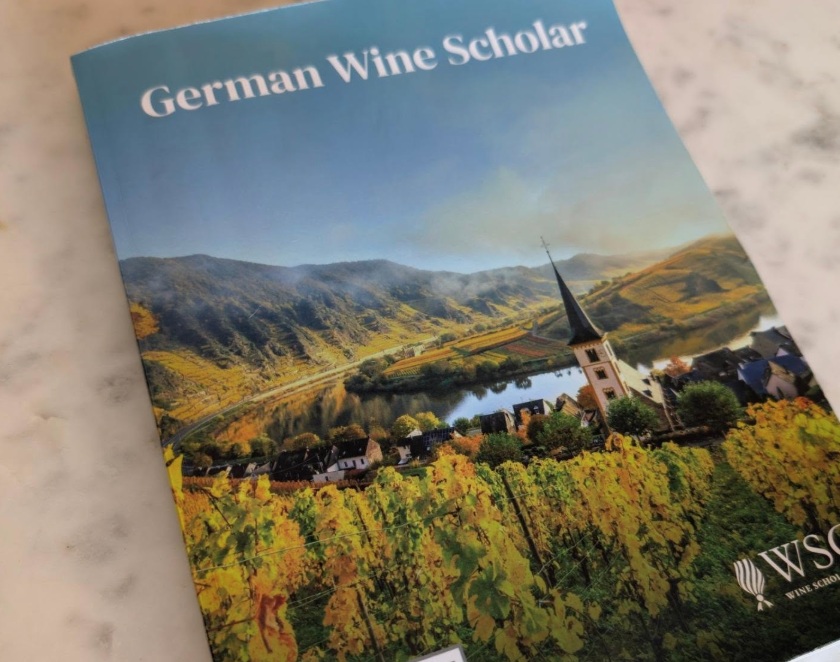
This one may be specific to the German Wine Scholar exam over others, but I’m going to say it anyway- knowing some of the language helps.
For most all of the country-level programs, you aren’t really expected to be fluent in the language to sit for the exam. I can probably count on one hand the number of non-food words I knew in German before starting this program. I am much more well-versed in Italian, French, and Spanish (i.e., the Romance languages) to various degrees of poor-but-better understanding.
But for the German program in particular, recognizing some words can be immensely helpful if only because many terms and phrases are Komposita, or compound words. Throw in that English is also a Germanic language, and there are many words you can start to recognize meaning simply by looking at the literal translations of the terms. You probably don’t need me to explain the translation of Fußball or Wasserfall- I’m guessing you can reason what those words mean in a few seconds.
Wine-focused examples here are some of the Bereiche in the Mosel. Moseltor, for example, means “Mosel Gate” and is located at the border with Luxembourg. The next Bereich in Germany is Obermosel, which means Upper Mosel. If you can also recognize that the Mosel River flows towards the northeast, it comes together logically- the Mosel Gate is the first Mosel Bereich in Germany, and Obermosel is the Upper Mosel because it is upriver.
This is just one of many, many examples we could give in how the German Komposita can provide context clues.
So spend some time with the glossary in the back of the book and isolate some key German terms inside compound words. This can go a long way with comprehension/logic/reasoning come exam time.
At Scholar Level, You Should Know Villages & Notable Vineyards
Coming into the Wine Scholar Guild class after finishing the WSET Diploma, I do think I had a pretty good edge in understanding things like Germany’s grapes, major regions, wine laws, climate, and other broader characteristics.
I talk about this more in my full German Wine Scholar review, but where I felt this program differed is that it takes a deeper dive into the districts, villages, and vineyard sites across the country. Where the WSET Diploma may stop at most of the 13 Anbaugebiete, the Scholar course really drives things home on the Bereich (District) and collective/single villages over, and over, and over again (and over, and over, and over- it’s a lot).
These will come up in your exam.
I am terrible at rote memorization, and German is one of my weakest languages of all of the major wine-producing countries in Europe to boot, so remembering the vast array of names of sites with a tighter focus beyond the district level was next-to-impossible for me- and there were several questions to this effect on the exam.
I can’t make many recommendations here on the best ways to memorize all of these. You may try to remember everything you can. You may strategize just a few (that’s what I tried to do, at least). You may try to learn basic language proficiencies to try to see if a keyword pops up. You may not study them at all.
These all come with some pros and cons, but the inevitability is you should expect village and vineyard site names to pop up on the exam, and that’s all there is to it. Ignore this at your own risk.
My Practice Test Was Easier Than The Real One
Finally, while I always try to avoid sharing anything that could point to specific exam questions in articles like these, I can safely say that the practice exam hosted on the German Wine Scholar program was much, much easier than the final exam- at least for me.
This is partly because the practice exam was 50 questions, not 100 (a lower sampling/possible mix of questions outright), and also because I felt like my final exam had much more detail-oriented questions overall. The structure was the same, but the depth of material just felt more intense.
Can I say this is true for other countries on the Scholar-level track? No. But I do admit that I studied a ton, took the practice exam, went, “oh that wasn’t too bad,” and then took the real exam, with the immediate response, “oh ok that was much worse.”
I think this is more a sign of the risk that a 100-question exam, covering a crazy amount of material, coupled with a 75% pass rate, carries. The mock exam questions are, individually, reflective of what you may encounter in the final exam. This is true. But the precise makeup of the final exam could literally cover anything and everything. So if you are struggling with a specific type of question and your exam just so happens to have more of those questions included, well, good luck.
That said, you can glean some information from the WSG-provided practice exam. Namely, review the questions you missed on the practice exam, see if there are any broad themes or categories you did not do well on (mine were regional soil types and villages/vineyard sites, naturally), and study those even more before taking the real exam.
I can’t make any promises about what you’ll see come exam day, but if it’s on the practice exam, you can at least reason that you’ll see some similar questions on the real one.
- For full disclosure: I took the practice exam, got a 79%, studied the categories that I missed for a few more days, re-took the practice exam, got a 90%, and then immediately took the real test and got a 79%. I’m not sure whether this helps or hurts, but I am sharing it for clarity.
- There is a 3rd party practice exam available here and German Wine Scholar flashcards available on Brainscape as well. I did not find the latter until after my exam where I saw fellow students recommend that deck in a WSG forum. I’ve used 3rd party Brainscape flashcards for other studies and have enjoyed them when they are done well (as always, accuracy of 3rd party tools may vary).
Overall, these are some things I wish I’d been told in advance of taking my German Wine Scholar exam, and hopefully they will help you better prepare for your own exam, no matter which level of Wine Scholar Guild studies you are taking!
Have you taken a Wine Scholar Guild course and have studying advice? Comment below to share, and be sure to include what country/region/level class you took, too!
To learn more about Wine Scholar Guild classes, click here.
Upgrade Your Home Wine Bar
Need to upgrade your wine bar? Grab some new wine accessories: