Published by Jeremy. Last Updated on September 8, 2026.
Disclaimers: We use demographic data, email opt-ins, display advertising, and affiliate links to operate this site. Please review our Terms and Conditions for more information. This website is intended for those of legal drinking age in your jurisdiction. To see more of our content, set us as a Preferred Source in Google.
After finishing WSET Diploma, I knew I wanted to continue my wine education with another school.
But before considering making the leap into the grueling world of Master of Wine, I heard great things about the country-themed classes at the Wine Scholar Guild.
Much like WSET, they had classes targeted more towards beginners (Essentials level) and other more in-depth tracks for advanced students such as myself (Scholar level and Masters level- the former focusing on countries and the latter on individual wine regions).
As the guild had recently released its newest country, German Wine Scholar, I thought it would be a fun one to start with and completed it within the first year of availability.
While I have a full German Wine Scholar review here (plus Wine Scholar Guild exam tips here), in this one I wanted to compare WSET vs. WSG courses and share the pros and cons of each in case you are trying to decide between the two schools for studying!
Note: At the time of publication, I have completed WSET Levels 2, 3, and Diploma, as well as the Wine Scholar Guild’s German Wine Scholar. I opted to jump to the harder Scholar program (and skip Essentials) as this is a common recommendation for those who are WSET Level 3 / Diploma certified. I do not have any firsthand experience with the lower-tier Essentials level, but will discuss it briefly below based on my current understanding and WSG documentation.
WSET vs Wine Scholar Guild – A Quick Breakdown
The Wine Scholar Guild has many class levels focusing on individual countries or regions, including an Essentials course (with an intermediate level of difficulty), a Scholar course (often considered advanced in difficulty), and a Masters Course (typically focusing on just one region, like Champagne, with the highest tier of difficulty). Essentials and Scholar exams are multiple choice, whereas the Master courses also have short-answer essays and a map exam element.
WSET also has many levels of classes ranging from very beginner to advanced, but instead of focusing on a single country or region, they take a broader look at wine production and global regions as a whole. WSET Level 1 is effectively an introduction and is best for true beginners, whereas Levels 2, 3, and 4 (also known as WSET Diploma) scale in depth, complexity, and testing style adjustments. Levels 1-3 have multiple-choice question exams, just like the Wine Scholar Guild, but Level 3 also has essays and tasting components, and the WSET Diploma (Level 4) is only essays and tasting components (no multiple-choice at all).
So in terms of content, there is a clear difference between the two- WSG focuses on single countries/regions, and WSET focuses on global wine knowledge as a whole.
The pass requirements for WSG and WSET courses (through Diploma) also vary. Wine Scholar Guild Essentials requires 60% to pass, whereas Scholar and Master levels require 75%. WSET requires a score of 70% to pass Level 1, but the pass mark drops to 55% for subsequent modules. This isn’t necessarily an inherent sign of difficulty, but the 75% score for a Scholar-level class is perhaps the most daunting here, as you have little room for error even with multiple-choice questions giving you 25% odds at the start.
One element I like about WSET over Wine Scholar Guild in this respect is that as you get into Level 3 and Diploma, the essay questions give you more chances to earn points for showing correct logic and reasoning on a topic overall (for example, evaluating impacts of weather and climate in a vineyard) over a multiple-choice question where you’re either right or wrong. Throw in the lower score required to pass higher-level WSET classes, and you have just a bit more wiggle room despite broader material being covered (and subsequently tested on).
- At the time of publication, WSG was rolling out a Wine Tasting Certificate and Wine Tasting Diploma as well; however, I did not include commentary on these above, as there is not much information publicly available right now.
The Main Difference in Content – Breadth vs Depth
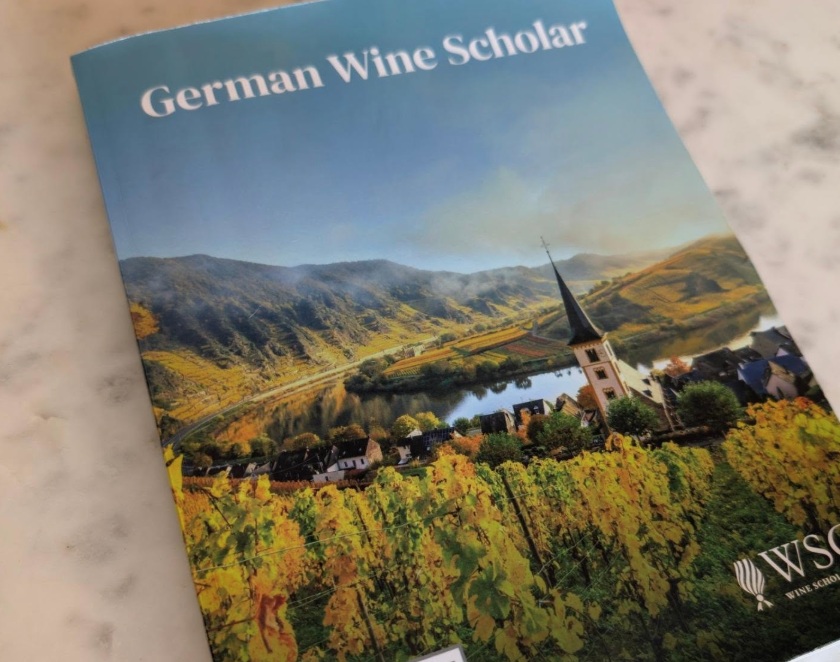
The biggest difference between the Scholar level classes with the WSG and any WSET program is that Wine Scholar Guild programs go into a much deeper dive on districts/sub-regions, villages, and vineyard sites in each of the major wine-producing areas in a single country.
The depth WSET provides for some of these may not be nearly as robust for any given region or country, simply because there is only so much material that can be covered in a global-level exam. (WSET’s coverage of grapes, viticulture/viniculture, laws, etc., is quite comparable, however.)
Another way to put this is that WSET focuses on breadth of material and wants you to make logical connections to how elements influence wine production worldwide, whereas the Wine Scholar Guild focuses on depth of material in one specific country.
Having come from a WSET background before doing Wine Scholar Guild courses, I had a very good understanding of the breadth of wine and could logic my way through many of the finer details introduced in the course here. But WSET also didn’t go into the extreme level of detail that the Wine Scholar Guild does for individual regions, either, especially at the Scholar level, so there were a lot more facts and history that may not necessarily translate to those same logic systems developed in WSET.
- To give an example from the German Wine Scholar program, WSET covered many of the 13 wine regions (Anbaugebiete), but not all. Some conversation was included on districts (Bereich), villages, and vineyards, but it was inherently limited. German Wine Scholar covered these ad nauseam and was thorough, to say the least.
This became a challenge for me in preparing for an exam because learning additional villages, vineyard sites, and other region-specific details was a lot and, depending on how many were actually asked on an exam, could really make or break my chances of hitting that 75% score to pass. I have to be honest- this was also the part that I liked the least, simply because I do not have the mental bandwidth to remember every fine detail.
Ultimately, I found that studying for logic-based essays and a structured WSET tasting grid made me look at things more critically, as opposed to the Wine Scholar Guild, which felt a bit more like rote memorization. At the end of the day, I felt like I learned more from the WSET program, whereas I more quickly memorized material to pass the exam with the German Wine Scholar program- but that is also entirely on me and my learning style, and your mileage absolutely will vary.
- As I had already passed WSET Diploma before diving into a Scholar-level class for Germany, I felt like I had a pretty good basis of understanding of about 50% of the material starting out. Things like climate, grapes, laws, and growing challenges were already covered in depth there, so much of this was topically something I already understood very well. If you are going in without this foundation, I would imagine that the Wine Scholar Guild courses would be more valuable and, by extension, even more difficult than what I experienced.
So, What Program Should You Take?
Given all these variables, it is hard to make an apples-to-apples comparison of the individual courses offered by the two schools. All told, that’s actually quite a good thing, as it means different interest levels and learning styles can find something that fits!
But if I had to speak in general terms on difficulties, though, I’d say Wine Scholar Guild may be a bit like a half-step up from comparable WSET programs on average. So if you’d like a program progression, I’d roughly sort them by the following logic using my own experiences and the WSG’s education path recommendations:
- If you know next to nothing about wine, start with WSET Level 1
- If you know a bit about wine already, say, having been to a vineyard or three, skip WSET Level 1 and begin with WSET Level 2
- These two levels offer great fundamentals in wine, and I’d recommend starting here before jumping over to a country-specific program unless you have a clear reason to do so (e.g., you’re moving to France and only care about French wines)
- I started on WSET Level 2 having traveled to a number of wineries before and had no issues with the material
- If you’ve completed WSET Level 2, a country Essentials-level course may be a good next step if you want to move to a single country; however, if you like the structure, WSET Level 3 is a great option to continue
- If you’ve completed WSET Level 3, a WSG Scholar-level course may be a good next step to dive deep on a single country
- If you’ve completed WSET Diploma, you could also choose to do a Scholar-level course if you’re interested in a particular country (as I did with Germany) or a Master level course if you are interested in a particular region- odds are good you have a sufficient foundation for either here
Where these programs are interesting is that, since they are completely separate from each other, you do not necessarily need to do one before another. The above is simply me trying to make a connection for those who have taken a class at one school and are trying to compare the other.
You could just as easily start with an Essentials course for the Wine Scholar Guild and then move on to a Scholar-level course to expand your knowledge, similar to how WSET students go from Level 1 to 2 to 3 to Diploma.
You’d have to really love one region to justify this, but you absolutely could.
Conversely, I also know people who took WSET Level 2, did not like the structure of the program/local school, and immediately switched over to a Scholar-level program with self-study from the Wine Scholar Guild and enjoyed the jump. This would be quite the level-up in difficulty, but it is not to say that it would be impossible- you just better be self-motivated to study all the same.
In fact, there was probably a lot more new material outside of the regional deep-dives mentioned above that could have provided a fair bit of value when going from WSET Level 2 to a Scholar level course- insofar as you are okay with the significant intensity jump. As I have yet to try an Essentials course, I cannot compare them definitively, but I do think those could be a good option to consider if you do not want an insane increase in difficulty, either.
For me, going from Diploma to a Scholar-level course was not that much of a jump in difficulty, even if there was much more material on the village/vineyard level in particular. It was still difficult because of this (I can’t reiterate this enough). But perhaps more importantly, I wasn’t quite sure if I got enough value out of it for the cost that others might- particularly those jumping from Level 2 or 3 over to Scholar and not from Diploma outright- I already knew a lot going into this one.
Despite this concern, I will likely do more Scholar courses with the Wine Scholar Guild and perhaps even a Masters level region eventually, if only because I always like to be studying something- but I am also not rushing to make my next booking right away, either, like I did when going through WSET’s program.
At the end of the day, the biggest difference, in my opinion, is that WSET focuses on global wine education in each module, whereas the Wine Scholar Guild focuses on a single country or region in much greater detail. Both have easier and more advanced levels (WSET Level 1/2 and Essentials vs. Level 3/4 and Scholar/Master, for example). From there, it really is a matter of preference for you and whether you’re looking for a deep dive in one location or a broader appreciation of global wine as a whole- and perhaps what kind of masochist you are for the respective exam styles.
To learn more about WSET, click here. To learn more about the Wine Scholar Guild, click here.
Upgrade Your Home Wine Bar
Need to upgrade your wine bar? Grab some new wine accessories: